- House dust mites love New Zealand. Healthify NZ says they may be more common here than in most other countries because of our climate.
- Look for a HEPA filter in a sealed vacuum. A leaky seal lets dust bypass the filter.
- Bagged vacuums keep dust contained when you empty them.
- No vacuum removes every allergen. ASCIA suggests someone else does the vacuuming if possible, and that you wait about 20 minutes before going back into the room.
If someone in your home has asthma, eczema or a dust allergy, the vacuum you choose matters. A good one picks up fine dust and keeps it locked away. A poor one can blow allergens back into the room. This guide covers what New Zealand and Australian health organisations say, and what to look for when you buy.
This guide is general information, not medical advice. If you have asthma or allergies, talk to your doctor or practice nurse about what’s right for you.
Why it matters in New Zealand
House dust mites thrive in moist conditions, and Healthify NZ says they may be more common in New Zealand than in most other countries because of our climate. ASCIA (the Australasian Society of Clinical Immunology and Allergy) also notes they’re common in homes with high humidity. Their allergen collects in carpet, sofas and bedding, which is why regular vacuuming with the right machine helps.
What to look for
- A HEPA filter. Healthify NZ says a vacuum needs a filter such as a HEPA filter, or fine particles are just spread around the room. Consumer NZ describes HEPA as trapping 99.97 percent of particles down to 0.3 microns.
- A sealed system. Asthma Australia points out that with a poor seal, some air escapes without going through the filter.
- Bagged, or easy to empty. Consumer NZ suggests a vacuum with a sealable, disposable dust bag. If you choose bagless, pick one that empties cleanly.
- Filters you can replace. Filters need changing or washing; Consumer NZ suggests about once a year as a guide, but follow your vacuum’s instructions.
Approvals you might see
- Sensitive Choice (blue butterfly): a programme run by the National Asthma Council Australia. Miele says Miele Australia and New Zealand partner with Sensitive Choice, and SEBO Australia says SEBO is a partner too.
- Allergy UK seal: Allergy UK was previously known as the British Allergy Foundation. Miele UK says the HEPA AirClean filters in the Complete C3 and Blizzard CX1 are approved by Allergy UK, and SEBO NZ lists a British Allergy Foundation seal for the Felix.
Filtration percentages in product descriptions are the manufacturers’ own figures.
Machines we stock that are worth a look
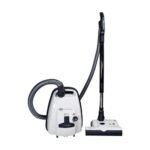
- Miele Complete C3: a bagged cylinder with a HEPA AirClean filter, which Miele UK says is approved by Allergy UK. See the Complete C3 Cat & Dog and C3 Complete Family All-Rounder.
- Miele Blizzard CX1: a bagless option. Miele New Zealand says the Blizzard CX1 is endorsed by Sensitive Choice. See the Blizzard CX1 Cat & Dog.
- SEBO Felix: an upright with SEBO’s S-class filtration, which SEBO NZ says is 99.9% effective to 0.3 microns, and a British Allergy Foundation seal listed by SEBO NZ. See the Felix Premium.
- SEBO Automatic X7 Boost: listed as a Sensitive Choice approved product in Australia. See the Automatic X7 Boost.
- Replacement filters: the Miele SF-HA 50 HEPA filter, the SEBO micro filter 6191ER and the SEBO filter kit 6696ER. Ask us which one fits your vacuum.
Vacuuming tips for allergy sufferers
- Vacuum carpets and sofas weekly, as ASCIA suggests.
- If you can, ask someone without allergies to vacuum, and wait about 20 minutes before going back into the room (ASCIA, Asthma Australia).
- Change bags before they’re full, and replace filters when the instructions say.
- Empty bagless bins outside, straight into a rubbish bag.
Frequently asked questions
Is a bagged or bagless vacuum better for allergies?
Bagged vacuums keep dust sealed inside the bag when you throw it away, which Consumer NZ and Asthma Australia both point to as a benefit for people with allergies. If you prefer bagless, choose one that’s easy to empty cleanly.
Will a HEPA vacuum get rid of dust mites?
No vacuum removes all dust mites or their allergen. ASCIA says HEPA vacuums may remove more allergen than other vacuums, but all vacuuming stirs some allergen into the air.
What does HEPA mean?
Consumer NZ describes a HEPA filter as one that traps 99.97 percent of particles down to 0.3 microns. The filter only works well if the whole vacuum is sealed, so air can’t leak around it.
How often should I change a HEPA filter?
Follow the instructions for your vacuum. As a guide, Consumer NZ says HEPA filters need to be replaced or washed about once a year.
What is Sensitive Choice?
Sensitive Choice is a programme run by the National Asthma Council Australia that approves products it considers suitable for people with asthma and allergies. Both Miele and SEBO take part in it.
Ask us for advice
Not sure which machine suits your home? Bring your questions into any of our stores, where you can see machines working before you buy, or chat with us online.
Sources
- Healthify NZ, Dust mite allergy: healthify.nz/health-a-z/a/allergy-dust-mites
- ASCIA, Allergen minimisation: allergy.org.au/patients/allergy-treatments/allergen-minimisation
- Consumer NZ, Asthma and allergens: consumer.org.nz/articles/asthma-and-allergens
- Asthma Australia, Can a HEPA filter vacuum help with allergies and asthma?: asthma.org.au/blog/can-a-hepa-filter-vacuum-help-with-allergies-and-as
- Miele NZ, Creating a healthier home with Miele vacuum cleaners: www.miele.co.nz/experiences/articles/creating-a-healthier-home-with-mi
- Miele NZ, Allergy-friendly home: the Blizzard CX1: www.miele.co.nz/experiences/articles/allergy-friendly-home-the-blizzar
- Miele UK, HEPA AirClean filters: www.miele.co.uk/m/990.htm
- SEBO NZ, Felix: www.sebo.co.nz/product/1932922
- SEBO Australia, About: sebo.com.au/company/about
- JB Hi-Fi Australia, SEBO X7 Boost listing: jbhifi.com.au/products/sebo-x7-boost-upright-vacuum-cleaner-automatic
- Allergy UK (formerly British Allergy Foundation): en.wikipedia.org/wiki/Allergy_UK

Written by the VacDirect team. We sell, service and repair vacuums, floor cleaners and robotic mowers from 8 stores across New Zealand, so our advice comes from what we see in the workshop every day.
Talk to a real person
Need help choosing?
Our team can match a machine to your home, or check whether your current one is worth repairing.